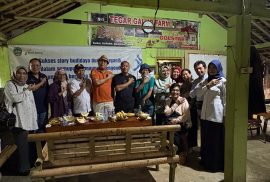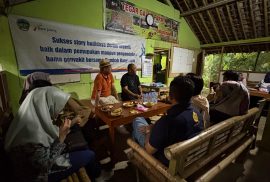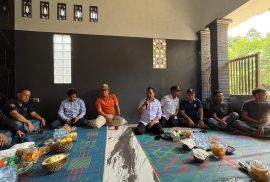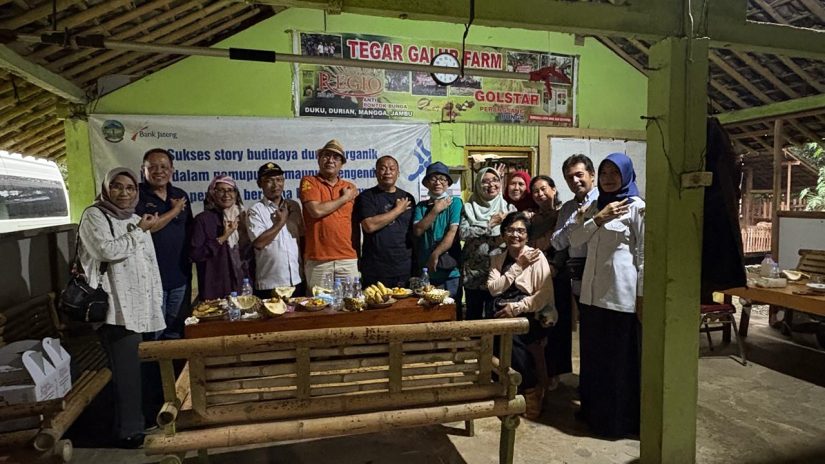
The Department of Plant Pests and Diseases (HPT), Faculty of Agriculture, Universitas Gadjah Mada (UGM), carried out a community service program in Dusun Siweru, Sigaluh Subdistrict, Banjarnegara Regency—known locally as the “Durian Village”—on February 4, 2026. The activity involved several faculty members from the Department of HPT, including Prof. Ir. Achmadi Priyatmojo, M.Sc., Ph.D., IPU., Prof. Dr. Ir. Y. Andi Trisyono, M.Sc., Dr. Suputa, S.P., M.P., Prof. Dr. Ir. Triwidodo Arwiyanto, M.Sc., as well as retired lecturer Dr. Ir. Sri Sulandari, S.U.
The program focused on strengthening the cultivation of premium durian varieties such as Musang King and Duri Hitam, which are widely grown by local farmers. However, several trees were reported to have not yet produced fruit. To address this issue, the academic team discussed the application of cultivation technologies, including the top working (grafting) method, which has the potential to enhance plant productivity. Under optimal conditions, a single durian tree can produce approximately 80–150 fruits per harvest season.
Dusun Siweru is part of the Rupaduri durian community, which has entered its second year of development. This year, the durian development program is planned to reach nearly all subdistricts in Banjarnegara Regency, covering an area of approximately 344,000 square meters with 2,782 recorded durian trees. In addition to orchard development, the Rupaduri community organizes training and educational activities for farmers, provides orchard maintenance assistance, and develops educational and business units that include fresh fruit production and durian cultivation learning programs.
The activity was accompanied by Mas Bayu, Chairman of Rupaduri, and Mas Hakim, Vice Chairman of Rupaduri, who play key roles in overseeing orchard management and maintenance. During the program, the service team also introduced the use of biological control agents as part of integrated pest management (IPM) and encouraged the development of superior local durian varieties through local variety competitions.
Technical discussions included fertilization strategies to stimulate off-season flowering, grafting and budding techniques, and environmental factors such as site-specific drought conditions. The Sigaluh area, located at an elevation of 500–600 meters above sea level, is considered suitable for durian cultivation, with optimal conditions at 600–700 meters above sea level.
Pollination ecology was also discussed, considering that the primary pollinators of durian are nocturnal bats, in line with the characteristic of durian flowers that bloom at night. This explains the limited role of diurnal insects such as bees and butterflies in the pollination process. To maintain fruit quality, farmers apply routine spraying every 15 days starting from the early fruit set stage (when the fruit is about the size of a coffee bean) to prevent pest and disease attacks.
The team also identified several durian plant diseases, including leaf blight, stem-boring pests, and pink disease, characterized by a white fungal layer on the stem that causes plant tissues to dry out. Additionally, extreme climatic conditions—particularly high rainfall—were reported to affect fruit quality, with some fruits ripening earlier without reaching optimal performance, while others mature later with better quality in subsequent stages.
Through this community service program, the Department of HPT UGM aims to strengthen the capacity of durian farmers in Banjarnegara through the transfer of cultivation technologies, pest and disease management strategies, and sustainable orchard management practices, thereby significantly improving both the productivity and quality of local and premium durian varieties.
This initiative contributes to the achievement of the Sustainable Development Goals (SDGs), particularly SDG 2 (Zero Hunger) through increased durian productivity, SDG 4 (Quality Education) through knowledge and technology transfer to farmers, SDG 9 (Industry, Innovation, and Infrastructure) through the application of environmentally friendly biological control innovations, and SDG 17 (Partnerships for the Goals) through collaboration between higher education institutions and farming communities in advancing sustainable agriculture.