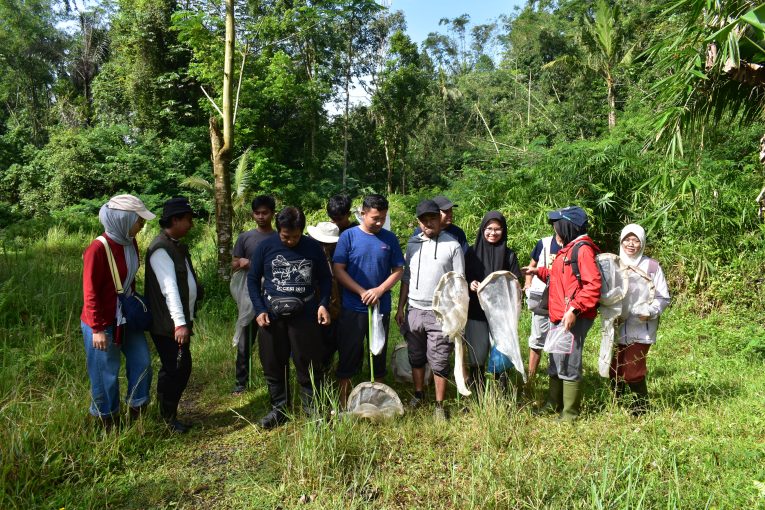


In March 2026, graduate students from the Master’s Program in Plant Pest Science conducted a field practicum on Insect Taxonomy and Systematics at Taman Lansia Ceria (TLC) Bethesda Yakkum and the nearby Kali Kuning area. This activity was designed as an integral part of experiential learning, aimed at enhancing students’ understanding of insect diversity, identification techniques, and collection methods in natural habitats. The practicum was supervised by Dr. Prayogo Probo Asmoro, S.P., M.Si. and Dr. Suputa, S.P., M.P., with support from teaching assistants Manda Rahma Cyntia, S.P. and Hanifan, S.P., M.Sc., who actively facilitated the technical aspects of the fieldwork.
Over the course of two days and one night, students engaged in a series of intensive and hands-on activities. These included the installation and utilization of various insect trapping methods, such as light traps for nocturnal insects, as well as yellow and blue sticky traps, yellow pan traps, and pitfall traps designed to capture insects with diverse ecological behaviors. In addition, students conducted direct exploration in the Kali Kuning area to collect insect specimens from their natural environments. Each collected specimen was carefully documented and analyzed as part of the taxonomic identification process. This immersive experience not only strengthened students’ technical competencies but also enhanced their analytical skills in understanding ecological relationships between insects and their habitats.
The outdoor learning environment provided a rich and dynamic academic experience, challenging students to adapt to real-world field conditions. Close interaction among students, lecturers, and assistants fostered a collaborative learning atmosphere, encouraged scientific discussions, and stimulated curiosity about insect biodiversity and its crucial role in ecosystem balance.
This practicum aligns with the Sustainable Development Goals (SDGs), particularly Goal 4 (Quality Education), Goal 13 (Climate Action), and Goal 15 (Life on Land). By emphasizing field-based learning on insect biodiversity and ecological interactions, the activity promotes awareness of biodiversity conservation and sustainable ecosystem management. It also contributes to shaping future researchers who are environmentally conscious and capable of delivering science-based solutions grounded in field evidence.