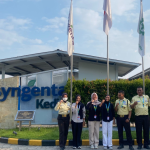
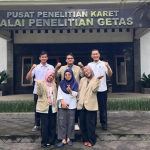
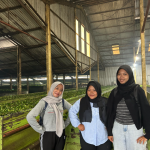
Nganjuk, Kediri, Blitar, and Tulungagung, June 23, 2026 – Researchers from the Nematology Sub-Laboratory, Department of Plant Pests and Diseases, Faculty of Agriculture, Universitas Gadjah Mada (UGM), conducted an extensive field survey and sampling of the plant-parasitic nematodes Meloidogyne spp. and Pratylenchus spp. on Tuesday (June 23). The survey covered multiple agricultural areas across Nganjuk, Kediri, Blitar, and Tulungagung Regencies as part of the PHC Nusantara Project and the Regular Fundamental Research (PFR) program funded through BIMA Kemdiktisaintek. The activity aims to generate comprehensive information on the distribution, diversity, and infestation levels of economically important nematodes affecting agricultural production in East Java.
The PHC (Partenariat Hubert Curien) Nusantara program is a bilateral research collaboration between Indonesia and France that promotes scientific partnerships, researcher mobility, and joint research initiatives between institutions in both countries. Meanwhile, the Regular Fundamental Research (PFR) scheme, administered through BIMA Kemdiktisaintek (Research and Community Service Information System), supports fundamental scientific research and innovation to address strategic challenges in agriculture and other disciplines.
The field survey was led by Dr. Muhammad Iqbal Maulana, S.Hut., M.Sc., together with Tiara Indah Wahyuni, S.P., M.Sc., Nada Ayu Nurlaili, S.P., M.Sc., and Juan Bastian, S.P., M.Sc. The research team collected samples from numerous sub-districts across the four regencies, focusing on rice fields, horticultural crops, and melon plantations, all of which are potential hosts of plant-parasitic nematodes.
During the survey, researchers collected both root and soil samples from fields exhibiting symptoms of nematode infestation as well as from production areas with a history of nematode-related problems. These samples will undergo laboratory analysis to identify the presence of Meloidogyne spp. and Pratylenchus spp., determine population densities, and evaluate their distribution across different agroecosystems. The findings are expected to support the development of science-based nematode management strategies and improve sustainable crop protection practices.
In addition to sample collection, the research team documented crop conditions, soil characteristics, and cultivation practices implemented by local farmers. These field observations will be integrated with laboratory analyses to better understand the relationships between environmental conditions, farming practices, and the occurrence of plant-parasitic nematodes in agricultural production systems.
By expanding the survey across four regencies, the research team expects to obtain a more comprehensive understanding of the distribution and diversity of Meloidogyne spp. and Pratylenchus spp. in East Java. The resulting data will provide an important scientific foundation for developing early detection technologies, sustainable nematode management strategies, and evidence-based recommendations aimed at improving agricultural productivity.
The survey of Meloidogyne spp. and Pratylenchus spp. contributes directly to several United Nations Sustainable Development Goals (SDGs). It supports SDG 2 (Zero Hunger) by strengthening research on plant-parasitic nematodes to improve sustainable agricultural productivity. The activity also advances SDG 4 (Quality Education) through field-based scientific training and research, SDG 9 (Industry, Innovation and Infrastructure) by generating scientific knowledge and innovation for plant health management, and SDG 17 (Partnerships for the Goals) through the PHC Nusantara collaboration, reinforcing long-term research partnerships between Indonesia and France in advancing plant protection science.